


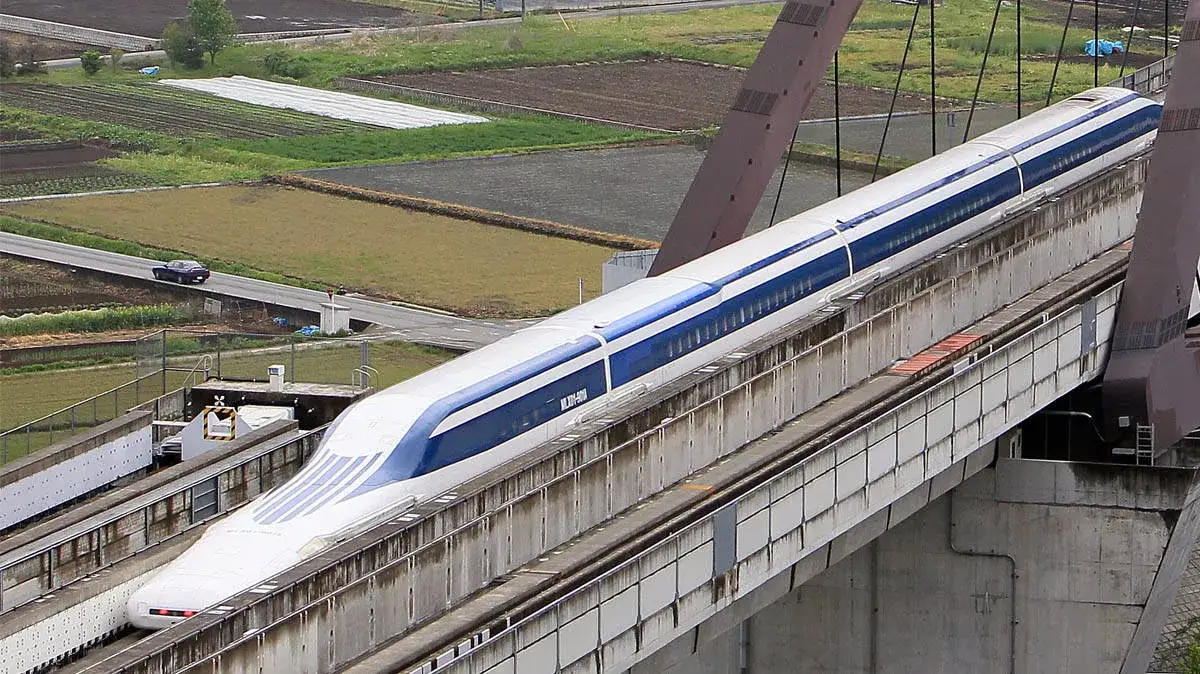
Countries around the world are developing technologies to increase the speed of bullet trains. Japan and China are at the forefront of this race. Now, both countries are competing to develop maglev technology capable of reaching speeds of 600 km/h.
Unlike normal trains, maglev trains use magnetic forces to lift the train above the track, allowing it to achieve very high speeds. This technology is considered capable of helping trains reach speeds of up to 600 km/h relatively easily.
Chinese manufacturer CRRC is developing a maglev train capable of travelling at 600 km/h. Japan is also competing in this race with its Chuo Shinkansen project. It uses Superconducting Magnetic Levitation, or SCMAGLEV, technology. During testing, a Japanese train reached a speed of 603 km/h.
Noriyuki Shirakuni, a Senior Corporate Executive Officer at Central Japan Railway Company, says that maglev technology developed outside Japan uses non-superconducting coils. According to him, these coils can lift a train about one centimetre above the track and enable it to reach speeds of up to 430 km/h.
The safety and comfort of the SCMAGLEV train are based on the fundamental principles of Japan's iconic Shinkansen bullet train. The project could not become a reality without Japan's extensive industrial capabilities. High-speed train journeys presently take around two hours, depending on the service. Once the maglev service begins, the travel time is expected to be reduced to about 40 minutes. It would take less than an hour to connect Japanese cities that are 286 kilometres apart.
The new high-speed train is expected to significantly reduce travel time between Beijing and Shanghai, says Ding Sansan, CRRC's Deputy Chief Engineer heading the company's maglev research and development division. Including airport procedures and other formalities, travelling by air between the two cities takes around 4.5 hours. A high-speed train takes about 5.5 hours. However, if the new maglev project becomes a reality, the journey could take just three-and-a-half hours.
There has been no confirmation yet about when China's new high-speed maglev train will begin commercial operations. Testing of the project is still underway, so passengers may have to wait a little longer. Japan's maglev project, however, is progressing according to its planned schedule. The first phase of the project connecting Tokyo and Nagoya was originally scheduled for completion in 2027.















 HOME
HOME LATEST
 NOTIFIED NEWS
 POLL
POLL KERALA
  EDITORIAL
  INDIA
INDIA  WORLD
WORLD  BUSINESS
  CINEMA
  SPORTS
  LIFESTYLE
  SPECIAL
  SCIENCE & TECHNOLOGY
 |
|