

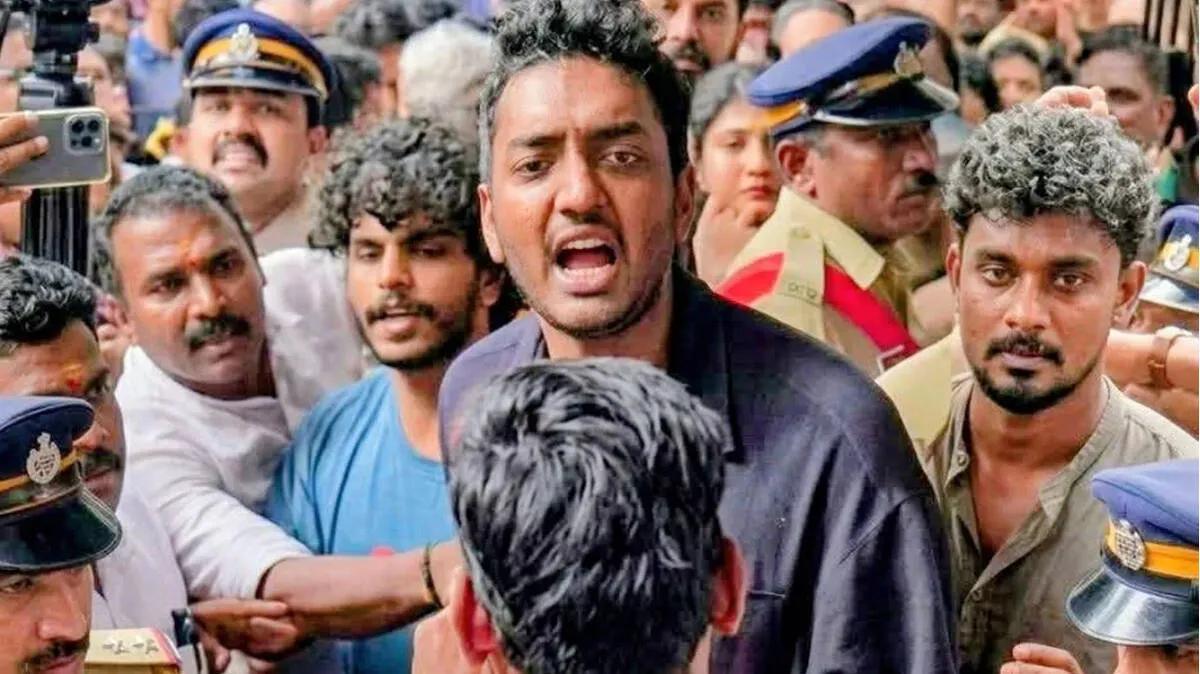
THIRUVANANTHAPURAM: Widespread debate has emerged over the conduct of digital media personnel who attempted to record videos on their mobile phones during the funeral of veteran actor Salim Kumar. The controversy gained traction after a video surfaced online showing Salim Kumar’s son, Chandu, confronting people at the venue. Producer Supriya Menon, wife of actor Prithviraj Sukumaran, also criticised the behaviour, labelling the actions as highly inappropriate.
Against the backdrop of the controversy, Kerala Police has now issued a public reminder about the legal consequences of recording or sharing private visuals of individuals without their consent. In a Facebook post, Kerala Police stated that capturing or circulating a person's private images or videos without permission could lead to legal action. The police noted that such acts may attract punishment of up to three years' imprisonment and a fine of up to Rs 2 lakh.
Kerala Police's Facebook post
This is a message for those who use mobile phone cameras to intrude into the lives and privacy of others. Human grief, death, public crises and accidents are increasingly being treated by some as opportunities to attract viewers on social media. Unnecessary interference and intrusion into a person's privacy pose a challenge to their fundamental rights and personal freedom.
It must be remembered that the Right to Privacy, guaranteed by the Constitution of India, is a fundamental right. Recording or sharing a person's private images or videos without their consent can lead to legal action. Under Section 66E of the Information Technology Act, 2000, capturing or transmitting photographs or videos that violate an individual's privacy is a punishable offence. Those found guilty can face imprisonment of up to three years, a fine of up to Rs 2 lakh, or both.















 HOME
HOME LATEST
 NOTIFIED NEWS
 POLL
POLL KERALA
  EDITORIAL
  INDIA
INDIA  WORLD
WORLD  BUSINESS
  CINEMA
  SPORTS
  LIFESTYLE
  SPECIAL
  SCIENCE & TECHNOLOGY
 |
|