


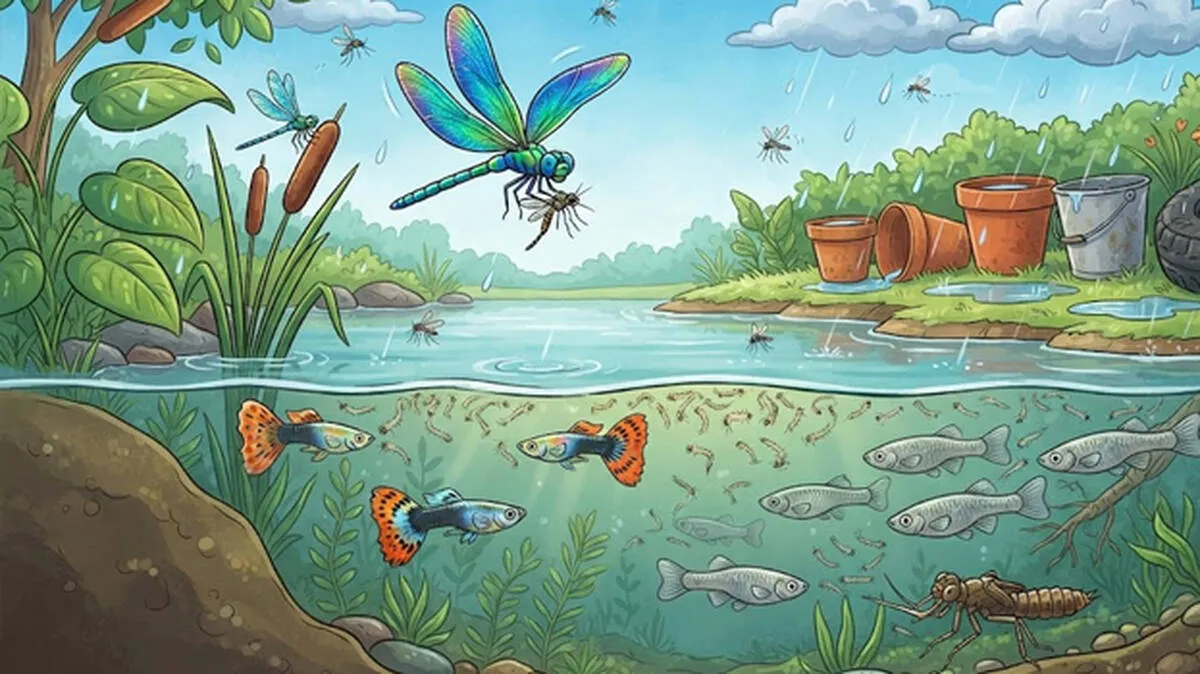
The monsoon brings welcome relief from the heat, but it also creates favourable conditions for mosquitoes to breed. With stagnant water collecting in and around homes, the risk of mosquito-borne diseases such as dengue and chikungunya can increase.
Mosquitoes are more than just a nuisance. They are among the most dangerous animals to humans because of the diseases they can transmit. While keeping the surroundings free of stagnant water remains one of the most important ways to control mosquito breeding, nature has its own tiny mosquito hunters too.
Here are a few creatures that can help keep mosquito populations in check.
Those tiny, colourful guppies commonly kept as ornamental fish may have another useful role. Guppies feed on mosquito larvae, which are commonly found in stagnant water.
They can therefore help reduce mosquito larvae in suitable water bodies. Guppies can be kept in appropriate tanks or ornamental ponds, making them an interesting addition to a garden where such water features are already present.
However, they should not be considered a replacement for basic mosquito-control measures. If water is allowed to remain stagnant, simply adding fish is unlikely to solve the problem.
Gambusia, often called mosquito fish, are another type of small freshwater fish known for feeding on mosquito larvae. Their larvivorous behaviour has made them useful in some mosquito-control programmes.
The water in which they are kept should be free from substances that could harm them, including excessive chlorine and pesticides.
There is also an important ecological point to remember: Gambusia should not simply be released into natural water bodies. Introducing fish into an ecosystem where they do not naturally belong can have unintended effects on native species and the wider environment.
The next time a dragonfly settles in your garden, there is no need to shoo it away. Dragonflies are natural predators of several small insects, including mosquitoes.
Adult dragonflies can catch flying insects, while their aquatic young, known as nymphs, also prey on mosquito larvae and other small aquatic organisms.
That does not mean a few dragonflies will suddenly make a home mosquito-free. Their presence is simply one part of the natural food chain and may contribute to keeping insect populations under control.
As interesting as these natural mosquito predators are, the simplest and most important step is still the most familiar one: do not give mosquitoes a place to breed.
Check flower pots, buckets, discarded containers, tyres, drains and other places where rainwater can collect. Empty or cover water-holding containers regularly and keep the area around the house clean.
Guppies, Gambusia and dragonflies may all have a role to play in nature's own mosquito-control system. But when it comes to protecting your home, eliminating stagnant water remains one of the most important steps for reducing mosquito breeding.















 HOME
HOME LATEST
 NOTIFIED NEWS
 POLL
POLL KERALA
  EDITORIAL
  INDIA
INDIA  WORLD
WORLD  CINEMA
  SPORTS
  LIFESTYLE
  SPECIAL
  SCIENCE & TECHNOLOGY
 |
|