


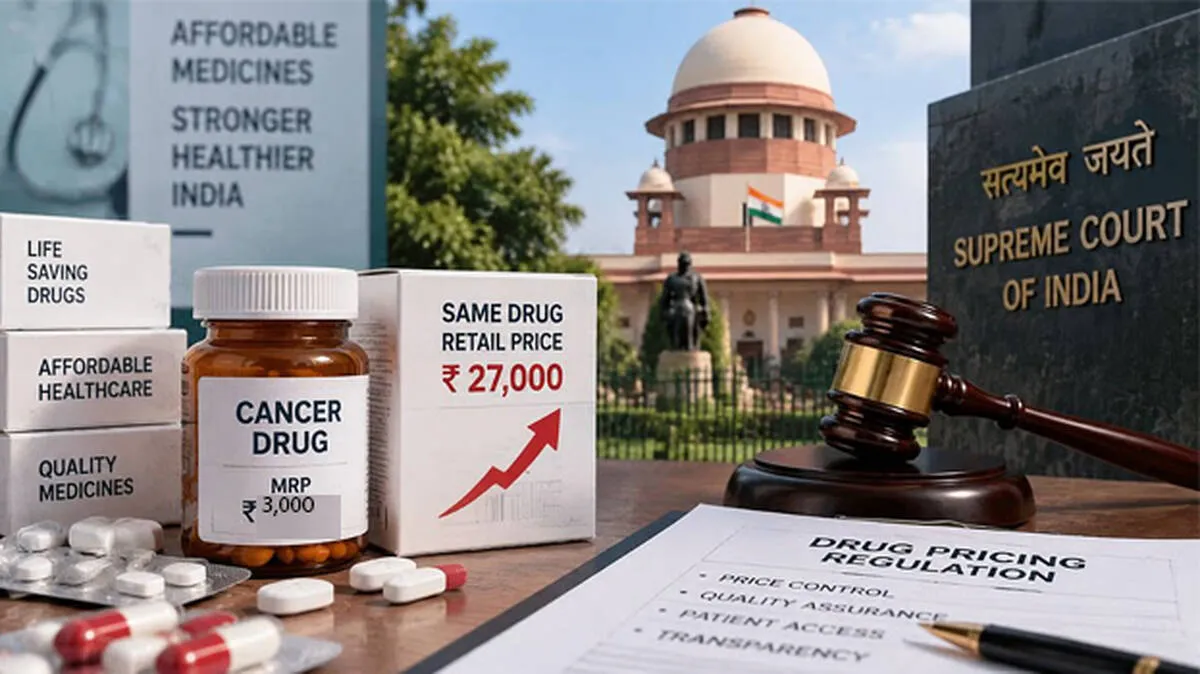
NEW DELHI: The Supreme Court on Tuesday took a strong view against patients being charged several times more for medicines used to treat cancer and other serious illnesses, saying there was a need for a uniform approach to regulate drug prices. A Bench of Justices Vikram Nath and Sandeep Mehta questioned the Centre over the wide gap between the price at which medicines are supplied to retailers and the maximum retail price (MRP) charged to patients.
The observations came after Solicitor General Tushar Mehta, appearing for the Centre, said the Drug Price Control Order does not apply to patented medicines. The Bench questioned why a uniform rule could not be brought in and asked the Centre to state its position when the case is taken up again on October 12.
The court said non-transparent pricing was causing hardship to ordinary people. It also noted that large private hospitals do not allow patients to purchase medicines from outside pharmacies at lower prices and instead require them to buy medicines from their own pharmacies.
The Bench also asked who would bear the cost when patients receive treatment at private hospitals under government health schemes.
When the Solicitor General said the government would bear the cost, the court observed that the money ultimately comes from taxpayers and said the burden was therefore being passed on to them.
The court referred to a cancer medicine with a price to retailer (PTR) of around Rs 3,000 but an MRP of around Rs 27,000, questioning how such a large difference could be allowed. PTR is the price at which medicine distributors supply drugs to retailers. MRP is the maximum retail price at which the medicine is sold to consumers.
The Bench referred to the 16 per cent retailer margin used under the existing drug price-control framework and observed that if a medicine priced at around Rs 3,000 were marked up by 16 per cent, it would cost about Rs 3,480. The court questioned why a similar uniform approach could not be considered more broadly. The Centre has been asked to respond when the matter comes up again on October 12.















 HOME
HOME LATEST
 NOTIFIED NEWS
 POLL
POLL KERALA
  EDITORIAL
  INDIA
INDIA  WORLD
WORLD  BUSINESS
  CINEMA
  SPORTS
  LIFESTYLE
  SPECIAL
  SCIENCE & TECHNOLOGY
 |
|