

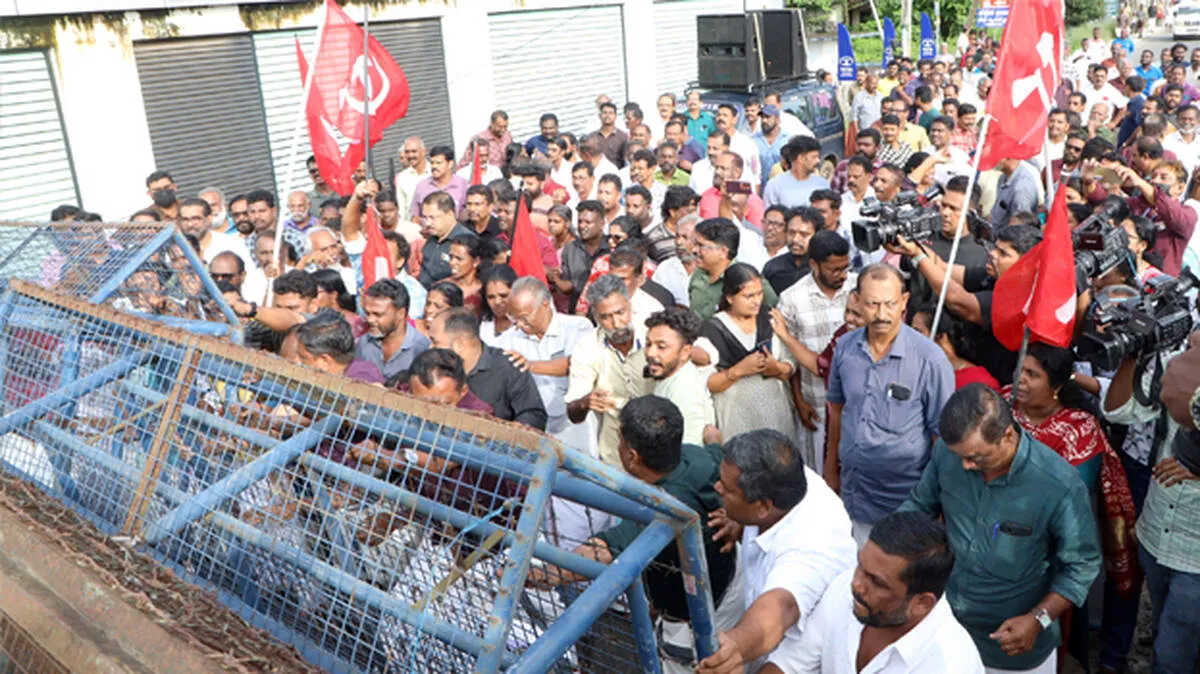
ALAPPUZHA: The political standoff between senior leader G. Sudhakaran and the CPI(M) leadership in Alappuzha intensified following a protest march staged by party workers to Sudhakaran’s MLA office in Kalarcode. The demonstration, which saw participation from prominent local figures including former MLA H. Salam, turned tense as protestors attempted to breach police barricades erected outside the office premises, leading to brief scuffles with security forces.
The friction between the two sides escalated following an incident at the SDV Government UP School in Neerkunnam, Ambalappuzha. Sudhakaran had visited the school to investigate complaints regarding the illegal smuggling of sand under the guise of building construction. The visit culminated in a heated verbal altercation between the senior leader and local CPI(M) workers, which reportedly escalated into a physical confrontation with the individual who had alleged the sand smuggling.
Adding to the rift, Sudhakaran's recent public criticism regarding the distribution of free food packets (pothichoru) at the Alappuzha Government Medical College Hospital heavily provoked the party leadership. In a social media post, Sudhakaran expressed disapproval over the practice of setting up temporary sheds to cook food on the hospital campus. He pointed out that while leftist youth organisations previously managed the initiative by collecting food packets directly from households, funds are now being raised from the public for this purpose.
Sudhakaran demanded that the financial accounts of these collections be submitted to the Hospital Development Committee, arguing that the government should ideally take over the responsibility of providing food. He noted, however, that there was no objection to cooking the food outside the facility and bringing it inside for distribution.
Responding to the criticism, CPI(M) District Secretariat member Manu C. Pulickal defended the current system and questioned the practicality of Sudhakaran's suggestion. He asked whether the government could realistically guarantee the uninterrupted daily distribution of the 2,500 food packets currently required by the hospital's patients and bystanders if it were to assume control of the initiative.







 HOME
HOME LATEST
 NOTIFIED NEWS
 POLL
POLL KERALA
  EDITORIAL
  INDIA
INDIA  WORLD
WORLD  BUSINESS
  CINEMA
  SPORTS
  LIFESTYLE
  SPECIAL
  SCIENCE & TECHNOLOGY
 |
|