


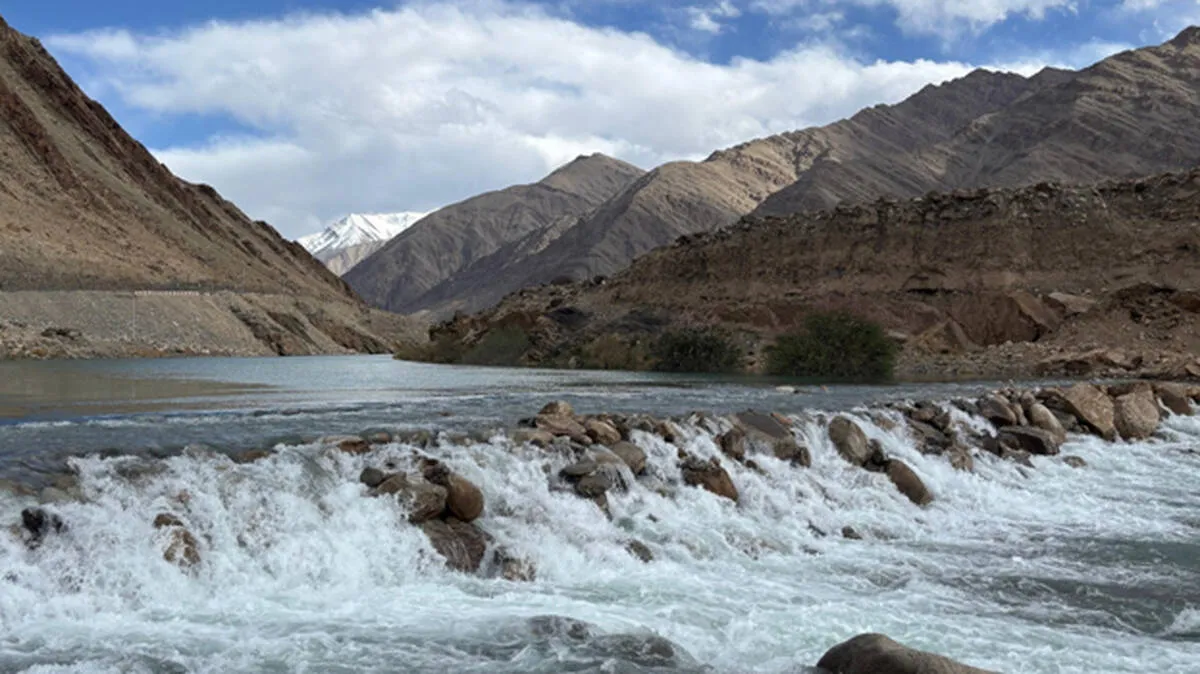
NEW DELHI: India’s first rock check dam on the Indus has been completed at Upshi in Ladakh amid Pakistan’s protests and legal challenge over the river’s waters. The structure has created a large pondage area upstream and can store nearly four crore litres of water, helping support irrigation. The water depth reaches up to 10 feet in the middle of the river.
Ladakh has been facing severe water shortages during the agricultural season. The stored water can be taken to agricultural fields through the Igoo-Phey canal. The development comes amid heightened tensions between India and Pakistan over the Indus waters, with water-storage projects being accelerated in Ladakh.
The flow of water has been regulated by constructing a five-foot-high barrier across the river channel in a valley. The dam is 200 feet long, has a base width of 30 feet and a top width of 15 feet. Rocks weighing between 500 kg and 10 tonnes were used in its construction.
Around 180 tonnes of rocks were used to complete the dam in seven days, from May 12 to 18, at a cost of Rs 10 lakh.
India placed the 1960 Indus Waters Treaty with Pakistan in abeyance in April 2025. On August 31, the Permanent Court of Arbitration in The Hague, acting on Pakistan’s application, ruled that the treaty remained in force. India rejected the ruling and the tribunal’s jurisdiction.
Thirty-six more check dams are proposed in Ladakh based on the Upshi model. A project proposal worth more than Rs 56 crore has been submitted to the Union Ministry of Jal Shakti for consideration.
The proposal includes seven Himalayan rock check dams in the Leh region and 29 RCC check dams or weirs in the Kargil region. The proposed projects are expected to provide irrigation to more than 18,600 acres of agricultural land.















 HOME
HOME LATEST
 NOTIFIED NEWS
 POLL
POLL KERALA
  EDITORIAL
  INDIA
INDIA  WORLD
WORLD  BUSINESS
  CINEMA
  SPORTS
  LIFESTYLE
  SPECIAL
  SCIENCE & TECHNOLOGY
 |
|