

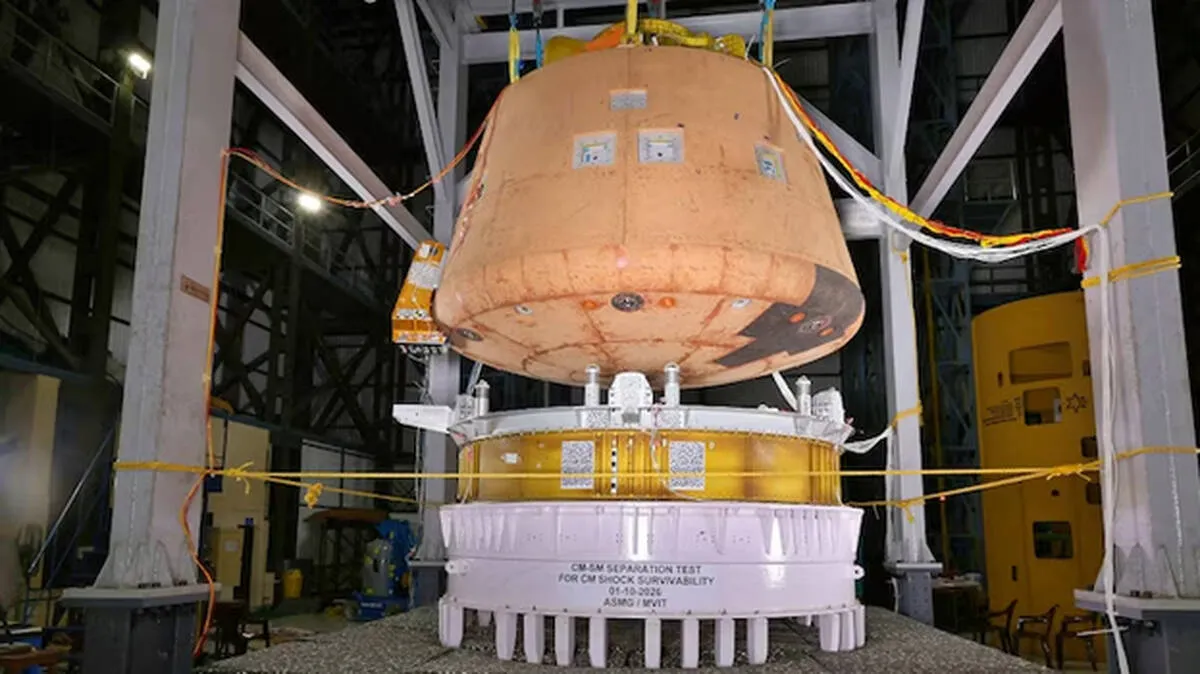
THIRUVANANTHAPURAM: The Indian Space Research Organisation (ISRO) has successfully completed a critical test to validate the separation of the Crew Module from the Service Module of its Gaganyaan human spaceflight programme. The test was conducted at the Vikram Sarabhai Space Centre (VSSC) in Thumba, Thiruvananthapuram, using a specially designed, large-scale test facility.
Gaganyaan aims to send Indian astronauts into space and bring them safely back to Earth. The separation test comes ahead of the programme’s first uncrewed mission, which is expected to be launched within the next two months.
The test involved separating the two modules at their interface, which incorporates several critical systems, including navigation equipment, electrical connections, propulsion-related mechanisms and thermal-control systems. These components must disengage in a precisely coordinated sequence. The test validated the automated control system designed to execute the separation. Any failure could jeopardise the Crew Module’s return to Earth.
The Crew Module (CM) is the habitable spacecraft that will carry the astronauts, while the Service Module (SM) houses essential support systems, including electrical equipment, reserve fuel and thermal control. The two modules will remain connected from launch throughout the orbital phase, as the spacecraft circles Earth at an altitude of about 400 km.
At the end of the mission, as the astronauts prepare to return to Earth, the Crew Module will separate from the Service Module and begin its atmospheric re-entry. The Service Module will be abandoned in space, while the Crew Module carries the astronauts back to Earth. The successful test marks another important step towards validating Gaganyaan’s systems ahead of its first uncrewed launch.











 HOME
HOME LATEST
 NOTIFIED NEWS
 POLL
POLL KERALA
  EDITORIAL
  INDIA
INDIA  WORLD
WORLD  BUSINESS
  CINEMA
  SPORTS
  LIFESTYLE
  SPECIAL
  SCIENCE & TECHNOLOGY
 |
|