

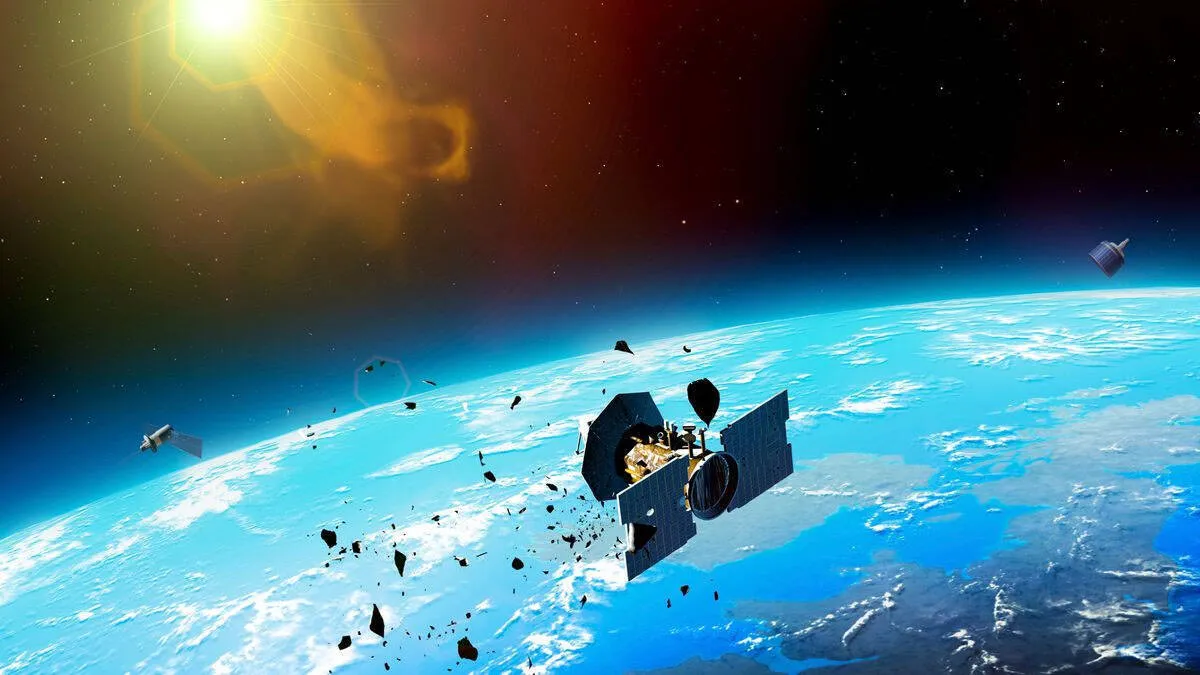
NEW DELHI: After nearly 22 years of service, Neil Gehrels Swift Observatory, a space telescope operated by NASA, is expected to re-enter Earth's atmosphere today. The spacecraft, weighing around 1.5 tonnes, is on its way back to Earth.
Reports suggest that parts of the spacecraft could fall in southern states of India, including Kerala, as well as parts of Maharashtra and Odisha. However, there is no confirmation about the possible impact locations. The Swift observatory is expected to enter Earth's atmosphere around 2 pm Indian time, though the re-entry could happen up to 11 hours earlier or later.
Launched in 2004, the Swift observatory was designed to capture images of powerful cosmic explosions across the universe.
The observatory's orbit gradually lowered due to increased solar activity. NASA had launched a robotic spacecraft built by a private company to capture Swift and move it to a higher orbit. However, the $30-million rescue mission failed after a part of the robotic spacecraft broke off in space. Swift was officially decommissioned on October 20.
NASA expects most of the spacecraft to burn up as it passes through Earth's atmosphere. However, some components are likely to survive the re-entry. Most of the debris is expected to fall into the ocean.
According to reports, parts of the spacecraft could potentially fall in southern India and near cities such as Mumbai, Hyderabad, Bengaluru, Chennai, Bhubaneswar and Kochi. The possibility of someone being injured by the falling debris is estimated at just one in 2,100. The debris is more likely to fall into the sea.
Although nearly 70 per cent of Earth's surface is covered by oceans, there is still a possibility of the debris falling on land. This translates to roughly a three-in-ten chance, according to Brad Tucker, an astrophysicist at the Australian National University, who spoke to ABC News.






 HOME
 LATEST
 NOTIFIED NEWS
 POLL
 KERALA
 EDITORIAL
 INDIA
 WORLD
 BUSINESS
 CINEMA
 SPORTS
 LIFESTYLE
 SPECIAL
 SCIENCE & TECHNOLOGY

 |