

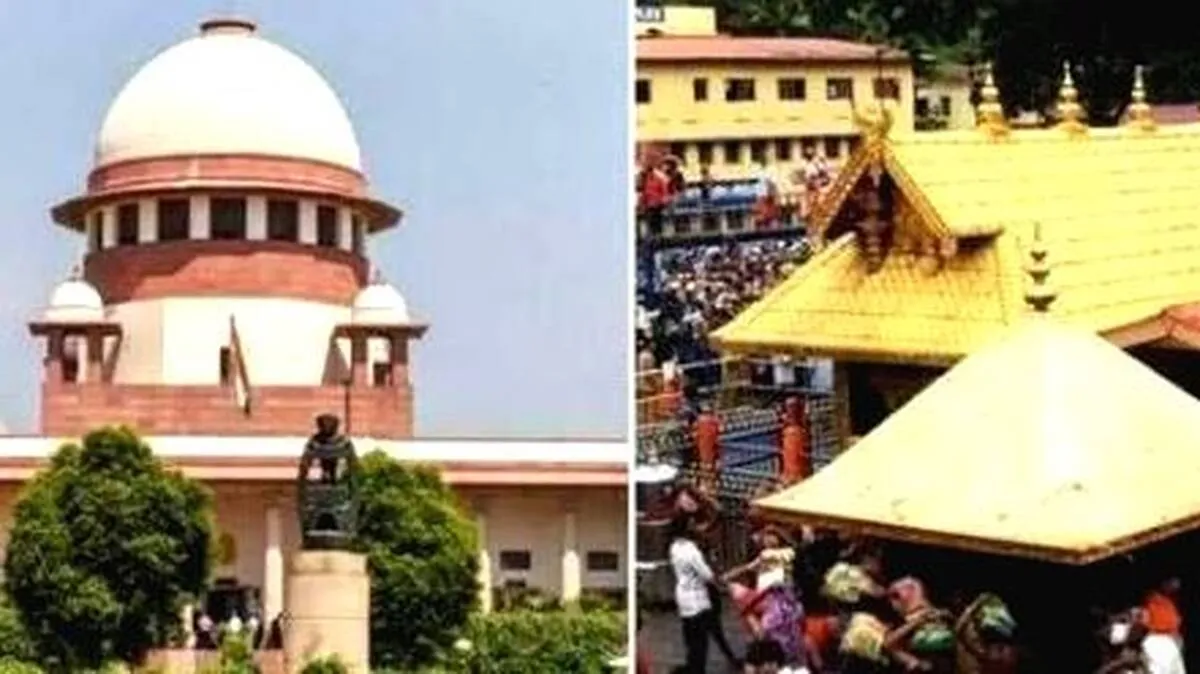
NEW DELHI: The Supreme Court's nine-judge Constitution Bench is likely to deliver its verdict this month on matters of faith, including the issue of women's entry into Sabarimala. Indications suggest that Justice B.V. Nagarathna, the only female judge on the bench, has begun drafting the judgment. During the hearings, Justice Nagarathna had observed that genuine female devotees aged between 10 and 50 would not visit Sabarimala but would instead remain at home. Other judges may draft their opinions either individually or collectively; the majority verdict will ultimately prevail.
In 2018, while four judges on the five-member bench ruled in favour of the entry of young women, Indu Malhotra—the sole female judge—dissented.
The verdict was reserved on May 14 after 16 days of hearings covering seven issues related to religious freedom, rights, faith, and practices. Arguments were also heard on petitions challenging practices such as female genital mutilation within the Dawoodi Bohra community and the denial of temple entry to a Parsi woman who had married outside her community.
Nagarathna’s observations:
1. The question of whether menstruation is a prohibition or not must be viewed from the perspective of the devotee.
2. Are Bindu Ammini and Kanaka Durga devotees?
3. Non-believers have no role in religious matters.
4. Ayyappa devotees view the ban on the entry of young women as a matter of tradition.
5. Religious freedom cannot be violated in the name of social reform.
9-Judge Bench:
1. The scope and limits of the fundamental right to freedom of religion under Article 25 of the Constitution.
2. The interrelationship between the individual rights enshrined in Article 25 and the rights of specific religious denominations/communities under Article 26.
3. Whether the rights of religious denominations are subject to Part III of the Constitution, which encompasses rights such as equality.
4. The scope of the term 'morality' as used in Articles 25 and 26; does it include 'constitutional morality'?
5. The extent to which religious practices can be subjected to judicial review.
6. The meaning of 'sections of the Hindu religion' as referred to in Article 25(2)(b).
7. Whether individuals belonging to one faith community can challenge the practices of another faith community through a Public Interest Litigation (PIL).














 HOME
HOME LATEST
 NOTIFIED NEWS
 POLL
POLL KERALA
  EDITORIAL
  INDIA
INDIA  WORLD
WORLD  BUSINESS
  CINEMA
  SPORTS
  LIFESTYLE
  SPECIAL
  SCIENCE & TECHNOLOGY
 |
|