

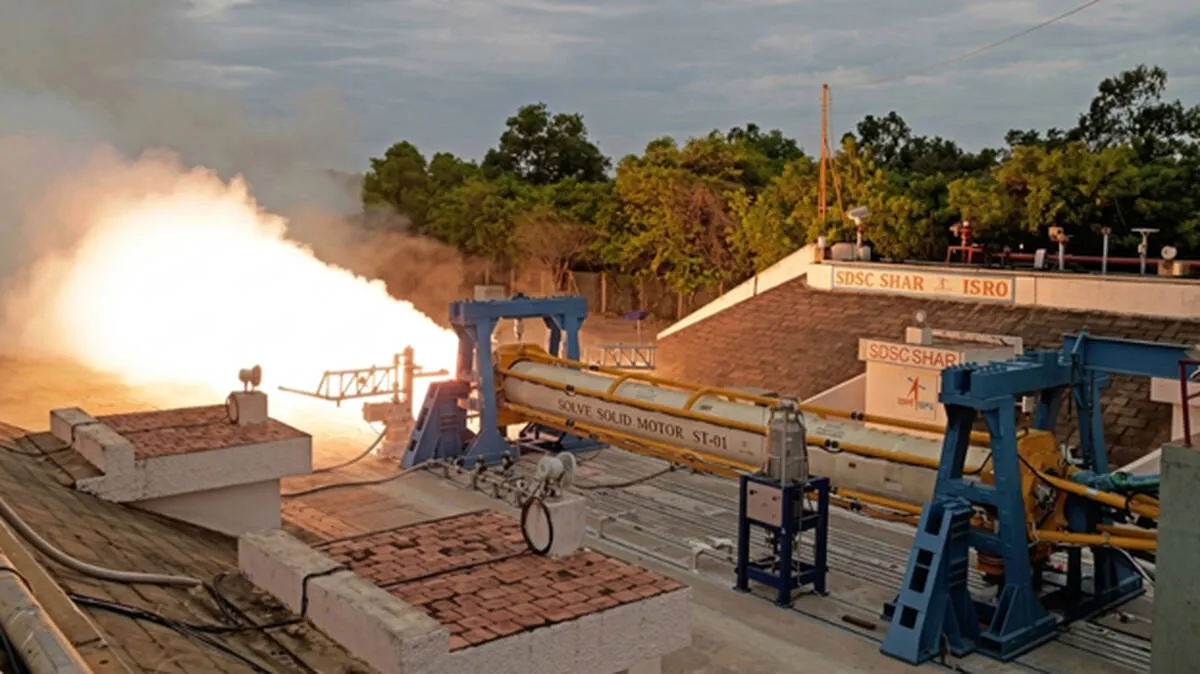
THIRUVANANTHAPURAM: The Indian Space Research Organisation (ISRO) has successfully developed a new compact test vehicle named SOLVE (Sub-Orbital Launch Vehicle for Experiments) to facilitate crucial validation trials for its upcoming Gaganyaan human spaceflight mission. The space agency marked a significant milestone with the successful first static ground test of the vehicle's solid motor at the Satish Dhawan Space Centre in Sriharikota.
The development of the SOLVE platform is specifically designed to conduct integrated parachute tests aimed at safely returning the Gaganyaan crew module back to Earth. The vehicle is engineered to carry the crew module to an altitude ranging between 10 to 17 kilometers before separation. Following the separation, a comprehensive sequence involving a series of 10 parachutes will be deployed to progressively reduce the module's descent velocity prior to its eventual splashdown in the sea.
To realise the new experimental vehicle, ISRO modified the existing solid-fuel strap-on motors utilised in its workhorse Polar Satellite Launch Vehicle (PSLV). The key modifications implemented to meet the rigorous safety and testing standards of the Gaganyaan program include the formulation of a slow-burning propellant and the integration of a straight nozzle featuring secondary injection thrust vector control.
The initial ground test of the SOLVE solid motor was performed at the Static Test Facility in Sriharikota, during which the motor was successfully fired for a prolonged duration of ten hours. Official parameters indicated that the performance of the motor aligned precisely with the space agency's expectations, providing critical flexibility for simulating diverse operational conditions for future test flights.
Gaganyaan represents India's maiden indigenous crewed orbital spacecraft mission. As part of the phased roadmap toward a human-rated flight, ISRO is scheduled to execute the first uncrewed demonstrator mission of the Gaganyaan program later this year.






 HOME
HOME LATEST
 NOTIFIED NEWS
 POLL
POLL KERALA
  EDITORIAL
  INDIA
INDIA  WORLD
WORLD  BUSINESS
  CINEMA
  SPORTS
  LIFESTYLE
  SPECIAL
  SCIENCE & TECHNOLOGY
 |
|